

In front of so much suffering, one cannot stand by and watch…
On 25 April 2015, Nepal was devastated by a terrible earthquake that brought the country to its knees, with thousands of dead, injured, displaced and countless children, women and men without medical care, food, clothing and a roof to shelter under. The main quake, with a magnitude of 7.8, was very strong and disintegrated thousands of homes, leaving many families with severe bereavements, without food or water, often left to their own devices on the side of a road. The entire country was brought to its knees, with 35 districts affected, 8600 dead, 20000 injured and 3 million earthquake victims.


Il Nepal ha richiesto l’aiuto internazionale e molte organizzazioni umanitarie si sono precipitate nelle zone terremotate per portare i primi soccorsi, concentrando i propri sforzi soprattutto nelle grandi città, ma trascurando i villaggi più piccoli e remoti, specie quelli posti a nord di Kathmandu, agli inizi della catena montuosa dell’Himalaya ad altitudini di 1500-1800 metri, penalizzati da grandi difficoltà di accesso alla regione.


Unfortunately, the greatest drama unfolded in these villages: small buildings made of poor materials collapsed miserably under the first violent earthquake tremor, bringing with them death and despair. The poverty of the population and the continuous aftershocks then made the tragedy even worse.
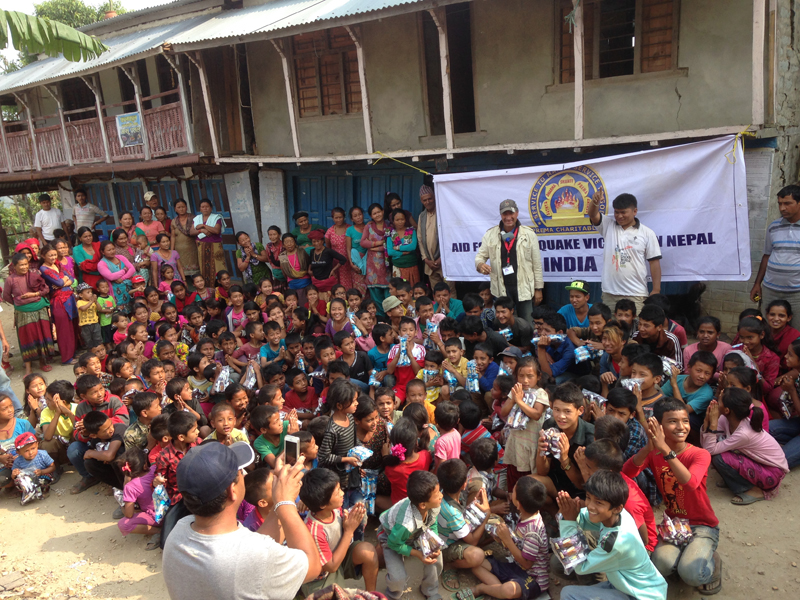
In front of so much suffering, the Sri Prema Charitable Trust, which makes charity and volunteer work its main mission, could not stand idly by. With volunteers led by Luigi Ferrante, a man who in the past has already led several humanitarian missions with self-sacrifice and spirit of sacrifice, bringing relief to thousands of victims of natural disasters, the Trust managed to bring concrete help to many villages in the Gorkha district, north-west of Kathmandu, delivering water, food and medicines. Starting from Channapatna, Karnataka, India, with a column of vehicles laden with the basic necessities, it reached and crossed the border into Nepal after endless days of travel and over 2000 km, and then headed into the Gorkha district, identifying and helping the small rural villages it found along the way.
In these villages there was a shortage of everything and we were able to deliver food, medicine and water to the population, distributing all the supplies that the Sri Prema Charitable Trust had provided and then continuing its work with an endless shuttle between Kathmandu, where it went to stock up on basic necessities, and the most remote and remote villages, where often no help had ever arrived since the day of the first earthquake tremor. Today, the Sri Prema Charitable Trust continues its commitment in Nepal, both through voluntary work and fundraising to contribute to the reconstruction phase, with the aim of building a primary school in the village of Ghyampesal at 1800 metres above sea level, in the area of the Village Development Committee of Masel, in the district of Gorkha, about 200 kilometres from Kathmandu. Once completed, the school will be able to accommodate up to 500 students, also from neighbouring villages, bringing hope and smiles back to the faces of many children. On 6 June, the first brick was officially laid and a commitment was made before the local authorities to complete the work… but the road is long and there is still much to be done to restore dignity and serenity to the Nepalese people.


“Every day is a miracle… When there is in the individual, a strong will to help and to serve, miracles happen… I believe that this is the only spiritual discipline to which we should dedicate ourselves. I was told one day… don’t forget that for all your efforts to succeed, Universal Love (Prema) is indispensable.” Luigi Ferrante

